|
Today’s Daily Chicagoan is brought to you, in part, by: |
 |
|
|
|
|
We hope you had a great holiday, Chicago. Start the new week with these stories from WTTW News. |
|
|
|
|
|
|
 |
|
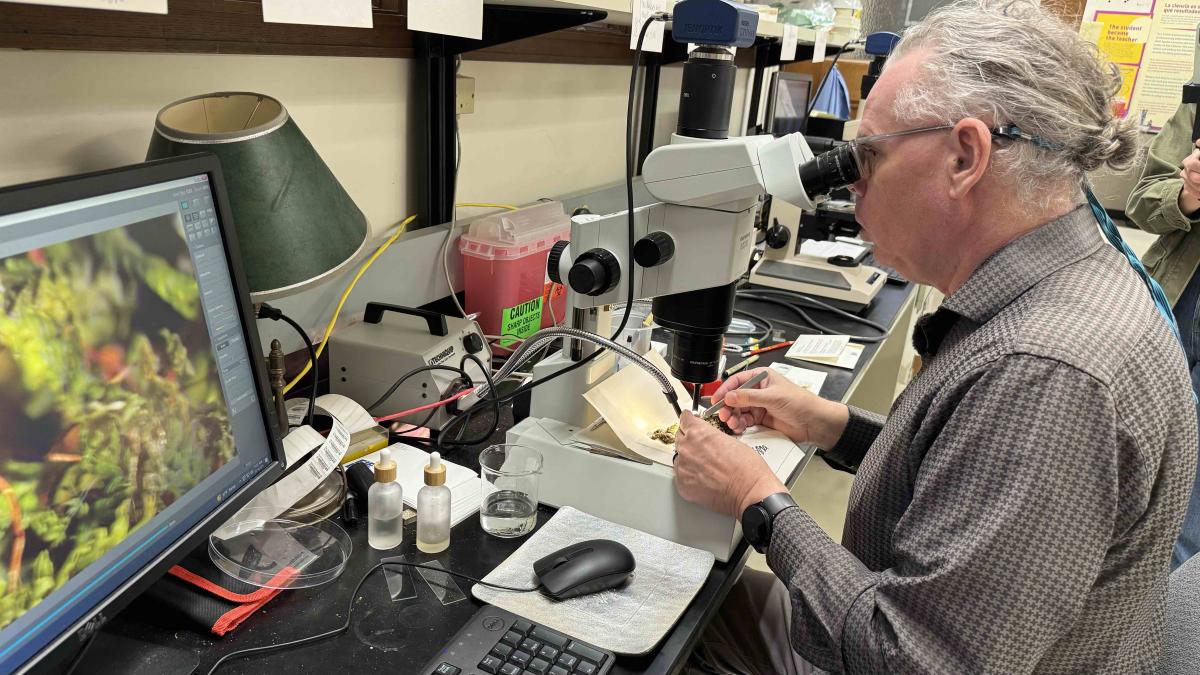
Field Museum research Matt von Konrat examines a specimen of moss under a microscope. (Patty Wetli / WTTW News) |
|
Detectives are using all kinds of gizmos and gadgets to solve crimes these days, from cellphone pings to facial recognition software.
But they’re overlooking a low-tech — actually no-tech — source of clues that’s quite literally underfoot.
It’s moss.
At least that’s the conclusion of a newly published study, led by researchers at the Field Museum. Matt von Konrat, head of botanical collections at the Field, is lead author on the paper, with an assist from Jenna Merkel, who interned at the museum in 2024 and is among the co-authors.
Some backstory:
They combed through 150 years of scientific literature looking for instances where moss may have helped crack a case, and they turned up roughly a dozen examples. The relatively small sample demonstrates the value of moss as a forensic tool, but also illustrates that it’s underutilized, von Konrat said.
“We wanted to highlight this to help law enforcement,” von Konrat said. “Hey, there’s microscopic evidence out there that we might be missing and that could be useful.”
Von Konrat isn’t just theorizing. He himself consulted on a case in 2013 in which moss was key to pinpointing the burial location of a murder victim in northwest Michigan.
A specific composition of plants, especially mosses, had been found on the soles of the suspect’s shoes. “There’s all sorts of fragments that you would never think of,” von Konrat said.
This is where a reference collection like the Field’s comes in handy, because there are hundreds of species of mosses in the Midwest alone. In the Michigan case, a half-dozen species were found on the shoes, which the Field was able to ID.
That information, in turn, allowed botanists, including von Konrat, to home in on the sort of micro-habitat where the plants could be found in combination.
“I describe it as we had several haystacks, and we could narrow the haystack where we were trying to find that needle,” he said.
Moss also supports other microscopic life — microorganisms, mites, insects, fungi and more — which can offer up additional clues. |
|
|
|
|
|
|
Sponsor Message |
|
Celebrate the holidays with Irving Berlin's White Christmas, on stage now at Paramount Theatre in downtown Aurora. It's the beloved story you know and love from the classic holiday movie, done with that Paramount flair that makes it an unforgettable experience. This family favorite brings generations together to celebrate the magic of the holidays. Don't miss out - get your tickets to White Christmas today! Visit ParamountAurora.com or call 630-896-6666. |
|
|
|
|
|
|
|
 |
|
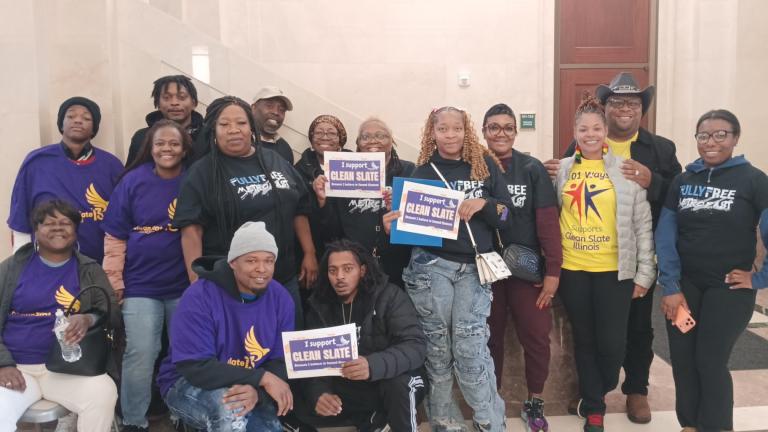
Advocates went to the Capitol on Oct. 28, 2025. (Courtesy of the Clean Slate Coalition Illinois) |
|
As he spoke to a room full of people impacted by the criminal justice system, and the activists who support them, 49-year old Marlon Chamberlain touted a recent victory.
“If you filled out a slip, jumped on a bus, made a phone call, sent an email — this is a win for us! We went to the Capitol saying ‘Clean Slate can’t wait! Clean Slate can’t wait!’” Chamberlain said to applause.
Chamberlain was celebrating the work of thousands of volunteers and activists who flooded the state Capitol in late October to lobby for legislation to help others like him. They finally notched the win during the General Assembly’s fall veto session with the passage of the Clean Slate Act, which is designed to automate the sealing of certain criminal offenses.
“It feels good,” Chamberlain said. “But the way I’m wired, my brain is instantly thinking about implementation. But this was a huge milestone.”
WTTW News first met Chamberlain two years ago, during our series on Permanent Punishment. Now, his work has led to the Clean Slate Act.
More context:
More than 2 million people in Illinois are eligible to have their records sealed but haven’t acted on what is currently a cumbersome, lengthy process.
“You can talk to one person who would say, ‘Hey, because I was well connected, supported in the nonprofit space, I had access to attorneys, and so for me it took six months,’” Chamberlain said. “But then there are some who we’ve spoken to where it’s been a three-year waiting period where it’s court dates that were rescheduled, canceled, or you didn’t have access to an attorney.”
“That’s not true justice,” said state Sen. Elgie Sims (D-Chicago), one of the bill’s chief sponsors. He said the process must be fair, equitable and open for everyone. |
|
|
|
|
|
|
|
 |
|
WTTW News Explains on Chicago's consent decree. (WTTW News) |
|
The dash-cam video of the murder of Laquan McDonald captured one of the darkest moments in the 190-year history of the Chicago Police Department. In response, Mayor Rahm Emanuel promised there would be “no U-turns on the road to reform.” But since city officials inked the 2019 police consent decree agreement, the effort has hit pot hole after pot hole. The consent decree is a binding court order granting a federal judge oversight of the police department. It was designed to correct the problems outlined by an investigation by the Justice Department – chiefly, that Chicago police were found to have routinely violated Black and Latino residents’ constitutional rights. While a consent decree can be a powerful tool to reform police departments, it is complicated. Click here to watch this WTTW News Explains video to see how it is supposed to work. |
|
|
|
|
|
|
Back in the Day: Dec. 1, 1958 - Our Lady of the Angels School Fire
|
|
Our Lady of the Angels School was a Catholic Elementary School on Chicago’s West Side that held around 1,600 students. On this day 67 years ago, a fire broke out in the basement of the building, originating from a cardboard trash can full of papers. The blaze burned undetected for 15 to 30 minutes before it came up the stairwell with billowing smoke, flames and hot gas. Ninety-two students and three nuns would die from the fire. A new school was later built on the same site in 1960, and the school would eventually close in the 1990s due to low enrollment. The tragedy was the subject of a “Chicago Stories” documentary, which you can watch here. |
 |
|
|
|
|
This Week’s Civic Events and Meetings |
|
Every Monday, WTTW News highlights the best ways to get involved with local government.
Greater Chicago Food Depository
This holiday season, why not volunteer or donate to a local food pantry? The Greater Chicago Food Depository has a variety of openings and needs that you can peruse here.
City Club of Chicago
On Tuesday at noon, Cook County State’s Attorney Eileen O’Neill Burke will join City Club of Chicago to talk about her first year in office and more. Buy tickets here.
Soup & Bread
On the first Wednesday of the month from December through April, the music venue the Hideout will host a community meal called Soup & Bread with pay-what-you-can donations directed to local hunger relief efforts around the city. The first installment of the season happens Dec. 3 from 6-8. RSVP here. |
|
|
|
|
|
|
|
|
Where's your favorite place in Chicago for holiday shopping? Tell us why.
|
|
|
|
Email DailyChicagoan@wttw.com with your responses and your answers might be published.
|
|
|
|
 |
|
|
|
5:30 PM | 10:00 PM |
|
|
|
|
Want more WTTW News content? Follow WTTW on Instagram to check in with us daily, go behind-the-scenes, and more. |
|
Newsletter Producer: Josh Terry |
|
|
|
|