|
Last week in this space I summed up a Chicago City Council committee subject matter hearing on urban flooding, in which the city’s efforts were characterized as inadequate and lacking a coherent, unified plan.
I swear the ink was barely dry on that column when I came across a New York Times Instagram post touting a study that ranked Chicago the “most resilient city in the world” in terms of climate adaptation.
“It’s in a temperate latitude, with good freshwater access and low hurricane risk. Adaptation efforts have included a long-term investment in robust infrastructure like the massive Deep Tunnel Project, which is meant to mitigate flooding and water pollution,” according to the Times coverage of the study.
I admit I side-eyed that characterization. Yes, agencies have sunk a lot of money into the Deep Tunnel, but Chicago is still stuck with 150-year-old pipes connecting to those tunnels and reservoirs. I suspect folks whose basements still reek of mold three years after epic rains in 2023 would beg to differ with the “most resilient” label, too.
So, I dug into the actual study, which was released in March of this year but only gained traction after the Times published an article on Sept. 3. Actually, nobody even really noticed that article until the Times boosted it on social media. Read into that what you will about the state of media today. |
 |
|
Chicago might not feel resilient after a summer of storms, heat and wildfire smoke, but it ranks high compared with other cities. (Michael Izquierdo / WTTW News) |
|
The study was conducted by AlphaGeo, a geospatial AI company. That means the results are based on stats — facts and figures, not anyone’s lived experience, or even anyone’s eyeballs on the ground.
To come up with the resiliency rankings — not of the entire world but of 72 cities chosen by AlphaGeo — the company scored each of those cities on 18 “hazard metrics.” Those hazards included: probability of landslide occurrence, annual days with more than 40 degrees Celsius (that’s 104 Fahrenheit), maximum continuous dry days and burnable fuel percentage in the vicinity, which is a factor in wildfires.
Sure, the study’s assessment of wind risk only considers hurricanes, not tornadoes or derechos, but when you look at the list of hazards collectively, and that they’re measured on a scale that goes from very low risk to very high, well, Chicago starts looking really, really good.
And that’s kind of the scary part. This past summer’s wildfire smoke, suffocating humidity and succession of storms left a lot of people feeling vulnerable. If this is what “most resilient” looks and feels like, we’re all on shaky ground. |
|
|
|
Patty Wetli
WTTW News Digital Reporter |
|
|
|
 |
ICYMI |
|
|
|
|
|
|
|
|
|
Thanks to our sponsors: |
|
|
|
|
|
|
|
|
Clippings: News & Notes |
 |
|
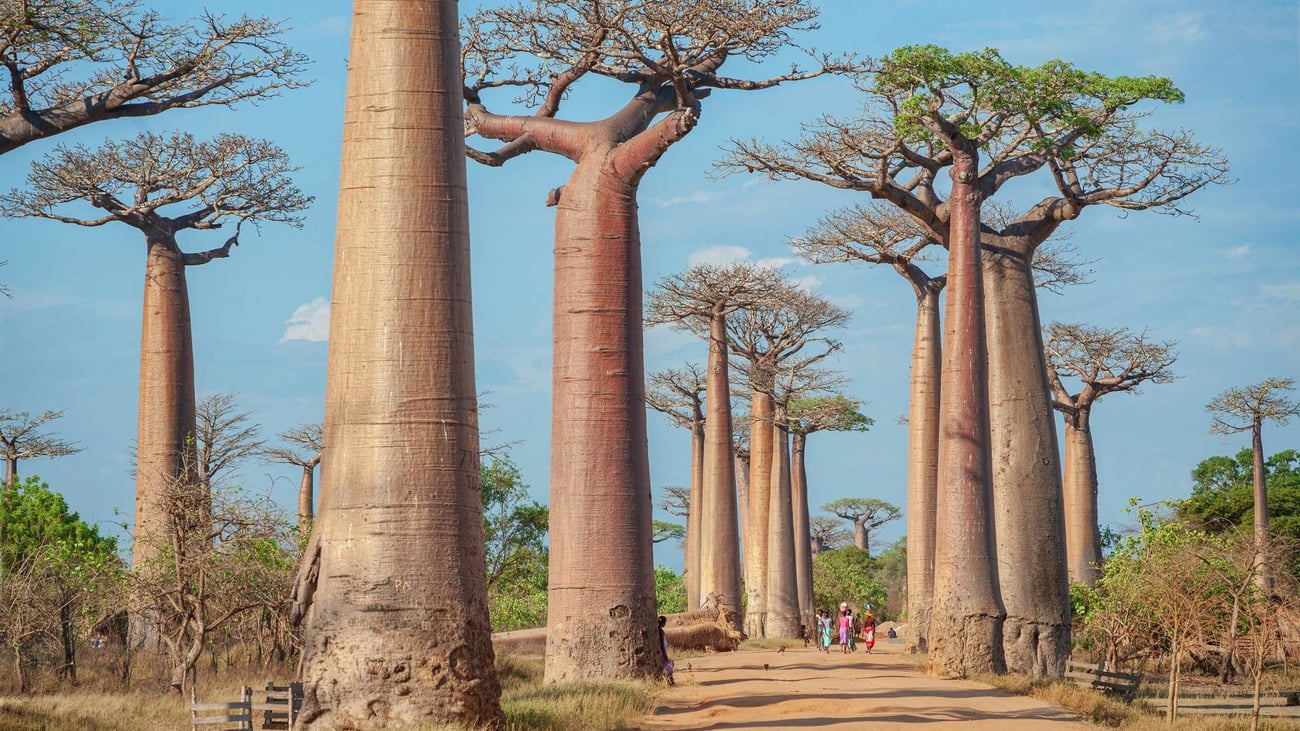
Baobab trees are among the most coveted by the wealthy, selling for $500,000 each. (yurybirukov / iStock) |
-
Illinois: Thanks to the dogged work and advocacy of volunteer bird strike monitors at the University of Illinois Urbana-Champaign, bird-friendly window film is being applied to the campus’ Business Instructional Facility at Gies College of Business, the Ward Lab for Ornithology reported. The building is one of the deadliest identified by an undergraduate-led Bird Strike Survey, ongoing since 2019. Windows of two additional buildings will be treated, with funding provided by the Student Sustainability Committee.
-
Local: Lake County Forest Preserves and the Forest Preserve District of Cook County are exploring a project that would make improvements to the Des Plaines River Trail as it approaches the bridge over Lake Cook Road, from both sides, as well as the bridge itself. To boost their chances of securing state funding for the project, the preserves are asking trail users to respond to a brief survey by Sept. 18.
-
Midwest: If we’re ever going to beat back buckthorn, we need more goats. This is a fun read from Minnesota Public Radio on the use of herds, not chemicals, to fight invasive species in local parks.
-
Nation: I admit I more or less rage-read this New York Times article, “The Latest Wealth Flex: Big Trees.” Essentially rich people will pay $500,000 for a mature, unusual tree rather than wait for young trees to mature. “A whole subculture has developed where trees are coveted like art and fetch similar prices,” is one memorable quote from the article. Here’s my personal favorite: “Yachts, houses, art, trees, it’s always essentially the same thing. It’s ‘My tree is bigger, my crane is taller, than yours.’”
-
Wildcard: Experts estimate as many as 30 million insects are out there, waiting to be identified. Well a researcher at the University of California Riverside just described a dozen new species and she gave some of them a particularly attention-grabbing name: meet genus Swiftiephylus, as in Swifties. “Taylor Swift’s iconic look is her blonde hair and red lips. These insects are pale yellow with accents of red throughout,” entomologist Sarah Schroeder said, as she explained her choice. The association with Swift might also, Schroeder said, get people interested in “the diversity of insects that has yet to be discovered.”
|
|
|
|
|
|
Creature Feature: Ghost Pipe
|
 |
|
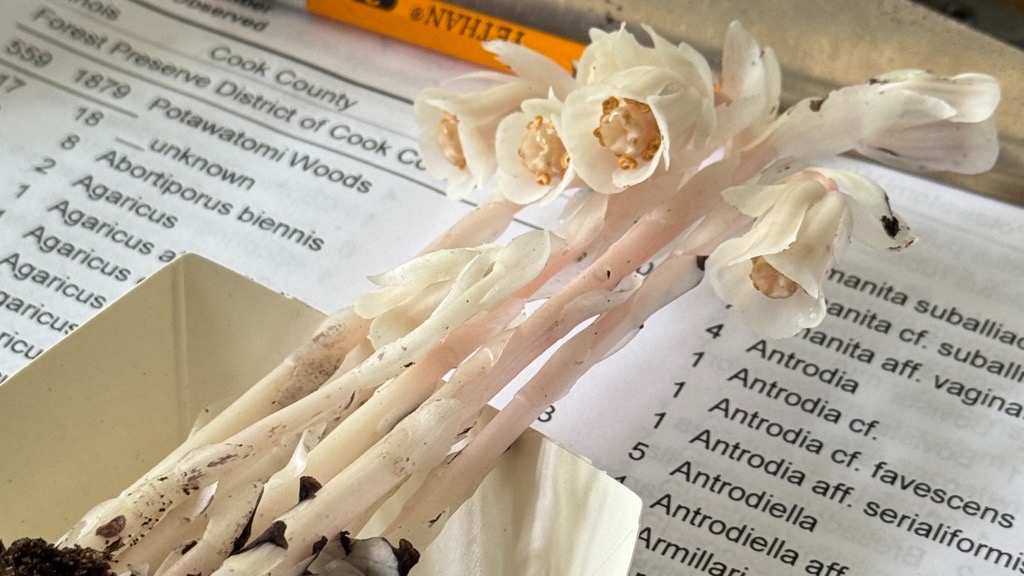
The ghost pipe is often mistaken for a fungus, but it's actually a plant. (Patty Wetli / WTTW News) |
|
Last weekend, I joined the Illinois Mycological Association on a fungal survey in the north suburbs. Split into two groups, we combed the woods for two hours, looking for fungi, and I was blown away by the diversity of our combined discoveries. But the coolest find made by one of my fellow foragers turned out to be a plant, Monotropa uniflora, otherwise known as the ghost pipe. How weird is the ghost pipe? Well it decided to skip out on photosynthesis, so it has no chlorophyll. Hence the “ghost” in ghost pipe. Instead, it gets its nutrients by parasitizing a fungus — the fungus draws nutrients from a tree and the ghost pipe accesses those resources through the fungus. |
|
|
|
|
|
Nature Calls: Events & Activities |
 |
|
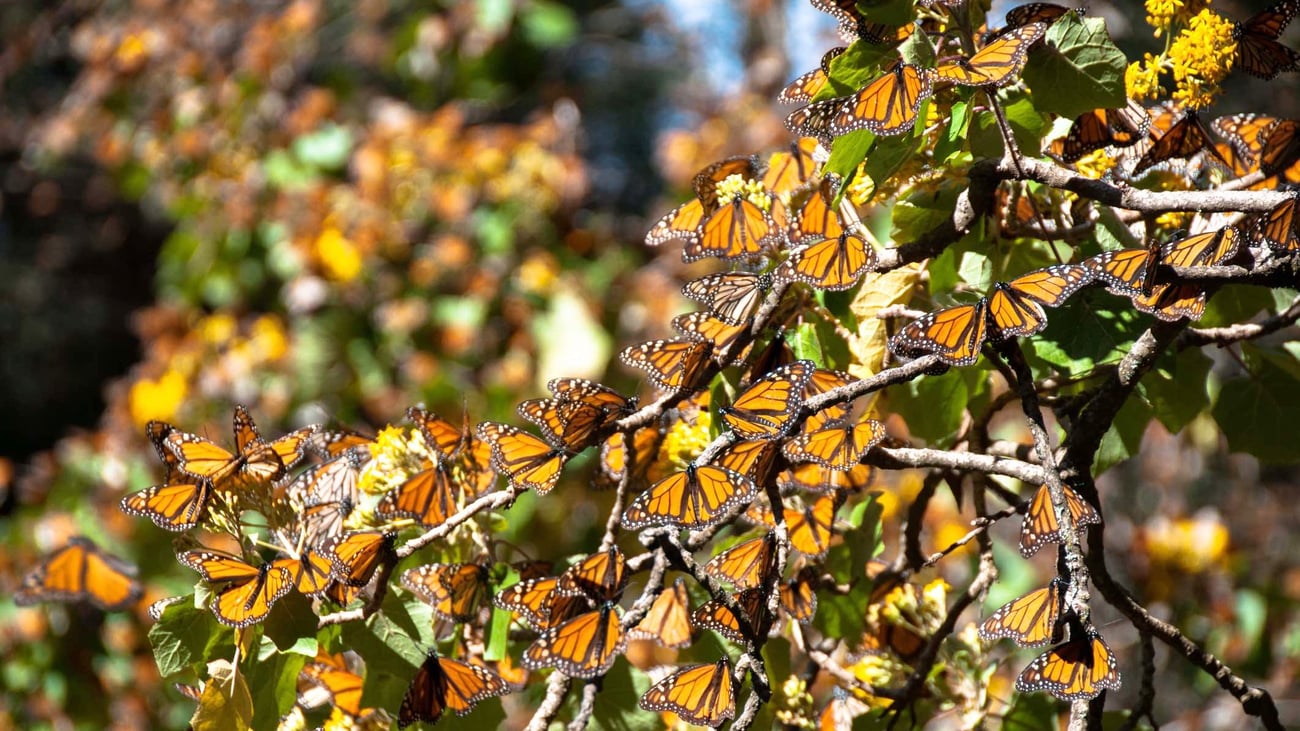
Monarchs are heading south and you can follow along and help track their movement. (Alberto Loyo / iStock) |
-
The Great Orb Hunt is on in Kane County, now through Sept. 30. Search for one of the 150 orbs hidden at LeRoy Oakes Forest Preserve, Burnidge Forest Preserve and the prairie path at Fine Line Creative Arts Center.
-
Enjoy some time outdoors while learning what you can do to help the environment at Fall Nature Fest, Saturday, noon to 3 p.m., at LaBagh Woods in Chicago. There will also be food, family-friendly games and a performance from the Jesse White Tumblers. If you didn’t catch the critically acclaimed play “Birds of North America” during its first wildly successful run at Red Orchid Theatre, it’s back for an encore, through Oct. 4. The plot centers on a father-daughter duo who bird watch together over the decades. Tickets are on sale online.
-
Join a guided history hike through Morton Arboretum’s west side, stopping at key sites including the Morton family cemetery, Saturday, 10 a.m. Registration is required; cost is $26 for non-members.
-
Monarch butterflies are on the move. As they make their way south to Mexico, follow along using the Project Monarch app, which tracks the journeys of individual butterflies that have been outfitted with teeny tiny transmitters. You can also use the app to record detections of butterfly signals and upload to Project Monarch as part of this community science project.
-
File this one away for next week: Birds and coffee, hosted by Red Hill Birding guides, takes place every Friday in September, 7:30-9:30 a.m. at the Jarvis Bird Sanctuary on the Chicago lakefront. Learn about fall migration and enjoy a cup of bird-friendly coffee.
|
|
|
|
|