Congrats, Chicago. You’re almost to the weekend. Start your Thursday with these stories from WTTW News.
|
|
|
|
|
|
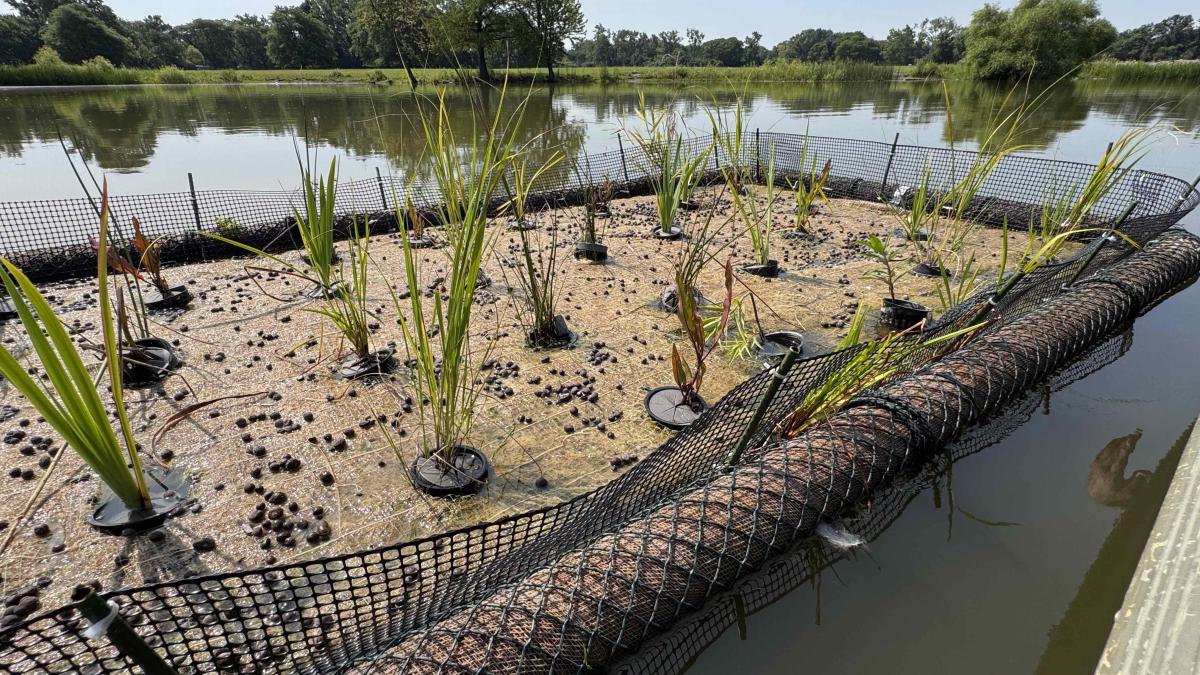 |
The Forest Preserve District of Cook County has installed its first-ever floating wetland at Schiller Pond. (Patty Wetli / WTTW News)
|
Compared with the Great Lakes, the six-acre Schiller Pond is a puddle. But this tiny body of water in Schiller Woods could wind up making an outsized contribution to conservation practices at the Forest Preserve District of Cook County, thanks to a first-of-its-kind pilot project for the district.
A floating wetland, roughly the size of a quartet of pool rafts tethered together, is anchored near the southern end of the boomerang-shaped pond. The 5-foot by 10-foot assemblage of PVC pipe, foam insulation board, coconut roll, clay pellets and plants supplied by the Chicago Botanic Garden is an experimental solution to a water quality issue at the pond.
“It’s so small,” Mike Feldmann, a fisheries technician with the forest preserve district, said of the wetland. “But building it, it felt really big.”
After visiting floating wetlands installed by Urban Rivers in the Chicago River and consulting with their experts, Feldmann and his colleagues in the district’s three-man fisheries division — Steve Silic and Jim Phillips are the other two — crafted their own $600 DIY version out of materials from Home Depot.
The fisheries team has already dreamed up an even more pared-down cost-effective configuration that can be turned over to Eagle Scouts for construction assistance.
The goal is to add another 100 or so of the plant-filled rafts over the next five years in order to achieve the 1.5% surface area coverage research suggests is necessary for such wetlands to be effective.
If the wetlands work as hoped, they’ll serve as a giant natural filter, removing the excess of phosphates and nitrates choking the pond and contributing to algae growth, a lack of oxygen and an impenetrable murk.
Some backstory:
The point of improving water quality is two-fold, as is the mission of the fisheries team, which is responsible for the district’s 44 lakes and ponds, all human-made.
On the one hand, the team’s goal is to maintain ecological sustainability in the aquatic environment. On the other hand, they cater to the public in terms of creating angling opportunities. Healthy fish habitat leads to healthy fish, which makes for happy anglers.
The plants installed in the floating wetland —hardstem bulrush, blue flag iris, prairie cordgrass, swamp dock, giant bur-reed and swamp milkweed — will uptake the phosphates and nitrates through their roots and store them in their stem and leaves.
That’s what wetlands do, floating or otherwise. They’re nature’s kidneys.
|
|
|
|
|
Sponsor Message
|
Bring the family and enjoy the fun!
July 25 & 26, 2026 | 10 a.m. – 4 p.m.
11141 S. Cottage Grove Ave, Chicago
Railroad Days is Chicago's premier railroad celebration! This year, we mark 100 years of electric rail. Join us for:
- Tour historic 1926 Pullman-built electric commuter cars
- Free STEAM Fair: From Rails to Rocketships
- WTTW’s Geoffrey Baer presents in historic Greenstone Church
- Walking tours, great food, mini steam train rides, face painting, live music, and more!
Grab a friend, and we’ll see you there! Kids 12 & under free. Tickets & info: friendsofpullman.com/special-events
|
|
|
|
|
 |
(Michael Izquierdo / WTTW News)
|
Chicago voters in the November election will get a chance to condemn the aggressive immigration raids sweeping Chicago — and demand that the Trump administration compensate the city after terrorizing and traumatizing its residents.
That question — posed by Mayor Brandon Johnson — will fill the final spot on the November ballot, ending a proxy fight between the mayor and his increasingly emboldened opponents on the Chicago City Council, even though the results will only carry symbolic weight.
Voters will be asked “whether the city shall pursue all lawful means to recover financial compensation from the federal government for the costs and economic harm caused by the Donald Trump administration’s ICE operations to recover lost tax revenue, public safety response costs and services provided to residents and families affected” by President Trump’s effort to implement the largest mass deportation effort in U.S. history.
“Chicagoans do not want to be terrorized, and Chicagoans do not want to have to pay for these terroristic actions,” Ald. William Hall (4th Ward) said, adding that many residents remain traumatized by the raids.
More context:
Only Ald. Anthony Napolitano (41st Ward) voted against putting the nonbinding question to voters. Alds. Greg Mitchell (7th Ward), Peter Chico (10th Ward) and Jeanette Taylor (20th Ward) were absent from the meeting or did not vote.
Napolitano has frequently opposed the city’s efforts to protect undocumented immigrants from deportation.
Each ballot can include no more than three nonbinding questions about citywide issues or policies during each election, giving officials a chance to drum up support — or opposition — from voters.
Voters will also get a chance to tell Johnson whether he should replace the city’s controversial gunshot detection system and an opportunity to urge city officials to create a permanent home for festivals and other large events.
However, Chicago voters will not get to weigh in on whether the Illinois General Assembly should impose a 3% surtax on those earning $1 million or more annually, either in November or in February, when all 50 alderpeople and the mayor face reelection.
|
|
|
|
|
|
|
|
|
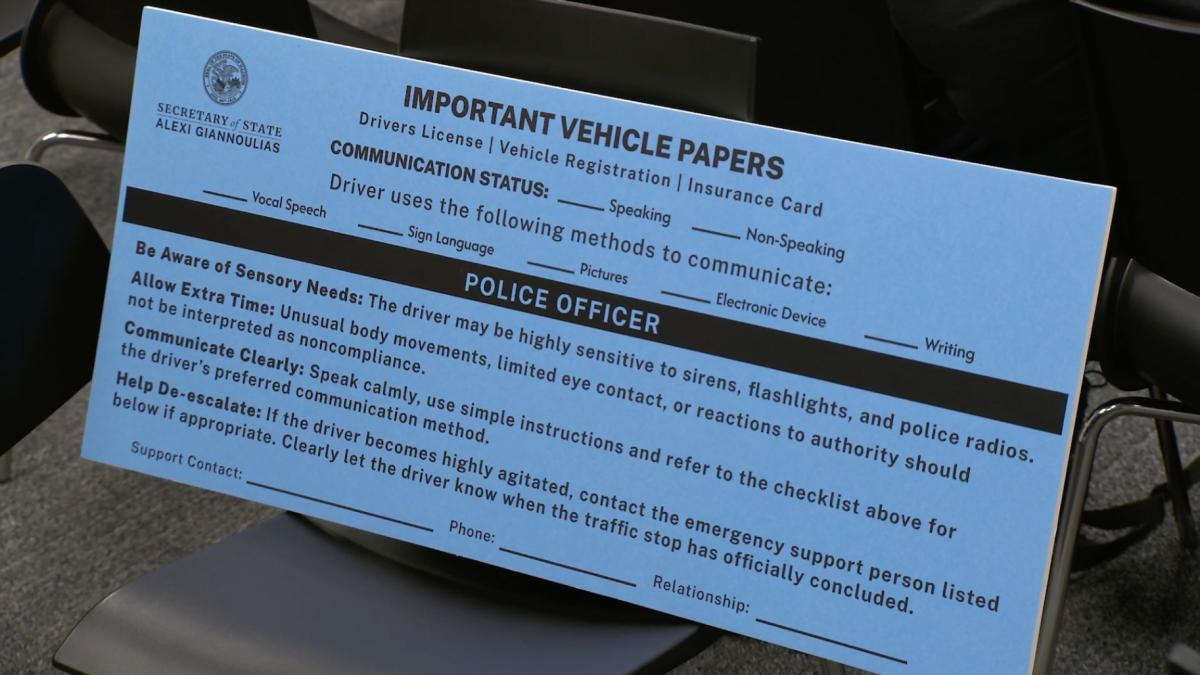
The statewide blue envelope program, launching next year, is a voluntary program that aims to improve interactions between law enforcement and individuals with autism. (Courtesy of Illinois Secretary of State)
|
A new statewide program launching next year aims to improve communication between drivers with autism and law enforcement officers during traffic stops.
The voluntary blue envelope program encourages drivers with autism to use a blue envelope to make officers aware of specific communication needs, potential sensory triggers and the need for patience during a traffic stop. The blue envelopes also include communication tips for officers and emergency contact information. Drivers can also keep their license, registration and proof of insurance inside the envelope.
“We know for many on the autism spectrum, even a routine traffic stop might not feel routine,” said state Rep. Michelle Mussman (D-Schaumburg) during a Tuesday news conference. “When a person has trouble communicating easily, and if they have characteristics that can be misinterpreted by an officer, the situation can quickly escalate.”
The program is being administered by the Illinois Secretary of State’s office, in partnership with law enforcement agencies and autism advocacy organizations, following recently signed legislation.
Illinois has other existing disability accommodations, such as voluntary designations associated with driver records and vehicle registrations. The blue envelope program aims to complement those other designations by providing an immediate, visual cue during traffic stops, according to a news release.
The Illinois Secretary of State’s office will provide the envelopes free of charge at DMV facilities and participating law enforcement agencies across the state, according to Secretary of State Alexi Giannoulias.
|
|
|
|
|
|
More From WTTW News:
|
|
|
 |
|
|
|
|
Back in the Day: July 23, 1925 - Union Station Opens
|
On this day 101 years ago, a formal grand opening ceremony was held to commemorate Union Station. The building, which sports a Greek Revival, Beaux Arts design was the brainchild of famed Chicago architect Daniel Burnham as part of his 1909 Plan of Chicago. Though Burnham died before construction was completed, the design and execution of his vision was taken over by the firm Graham, Anderson, Probst and White. Upon its opening, the railroads associated with the construction of the $75 million building handed out a brochure that read, “America’s latest triumph in railroading – the Chicago Union Station...fulfills the requirement of the public for a passenger terminal in Chicago that should combine convenient location and most advanced facilities with an architectural dignity befitting the center of the world’s railway transportation.” Last year, Gov. JB Pritzker and other officials held a press conference celebrating Union Station's centennial. As of 2025, more than 100,000 passengers pass through Union Station each day.
|
|
|
|
|
|
This Week’s Arts and Culture Events
|
|
Every Thursday, WTTW News newsletter producer Josh Terry highlights his picks for the week’s must-see cultural events.
I don’t need to tell you how the blanket of thick wildfire smoke engulfing Chicago last week torpedoed plans. But now, with the AQI currently in the green, you also have the green light to take in everything this city has to offer. While the four events listed are just a small selection of what you can do to satiate your cultural and artistic appetites, you won’t be led astray with any of them.
Musical: “& Juliet” — Auditorium Theatre
Penned by David West Read, a writer and executive producer behind the beloved Canadian sitcom “Schitt’s Creek,” the musical “& Juliet” is a humorous take on the Shakespeare classic that imagines “What if Juliet did not kill herself and moved on with her life?” Though it first debuted in Chicago in 2024, it’s back for a limited run at the Auditorium Theatre. Expect a jukebox-like song selection of Max Martin hits and a production that the Reader called “a coming-of-age story that will transcend generationally through song and meaning.” Buy tickets here.
Performance: CSO at Ravinia — Ravinia
Every summer, the Chicago Symphony Orchestra temporarily ditches its Symphony Center Loop home for the greener, North Shore pastures of Highland Park’s Ravinia Festival. This weekend, you have three opportunities to see the city’s premier classical music ensemble perform. The first is tonight, where conductor Marin Alsop leads a performance of Mahler’s Sixth Symphony. On Friday, Alsop and Laura Karpman will curate a setlist of songs featured in movies that women wrote. Finally, their busy weekend concludes Saturday by backing up the rock artist St. Vincent. Buy tickets to each event here.
Film: Éric Rohmer’s “Six Moral Tales” — Music Box Theatre
Lakeview’s Music Box is hosting a perfect introduction to one of the leading auteurs of French New Wave cinema with screenings of Éric Rohmer’s “Six Moral Tales” running from Friday through the end of the month. Each film in the sextet, which is composed of shorts and features released from 1963 through 1972, highlights the ethical and personal quandaries that come from romance, temptation, desire and relationships. For a full list of the schedule, tickets and screening times, click here.
|
|
|
|
|
|
|
What's your favorite local festival to attend during a Chicago summer?
|
|
|
Email DailyChicagoan@wttw.com with your responses and your answers might be published.
|
|
|

|
|
5:30 PM | 10:00 PM
|
|
|
Want more WTTW News content? Follow WTTW on
Instagram to check in with us daily, go behind-the-scenes, and more.
|
Newsletter Producer: Josh Terry
|
|
|
|
|