Today’s Daily Chicagoan is brought to you, in part, by:
|
|
|
|
|
|
|
|
 |
(WTTW News)
|
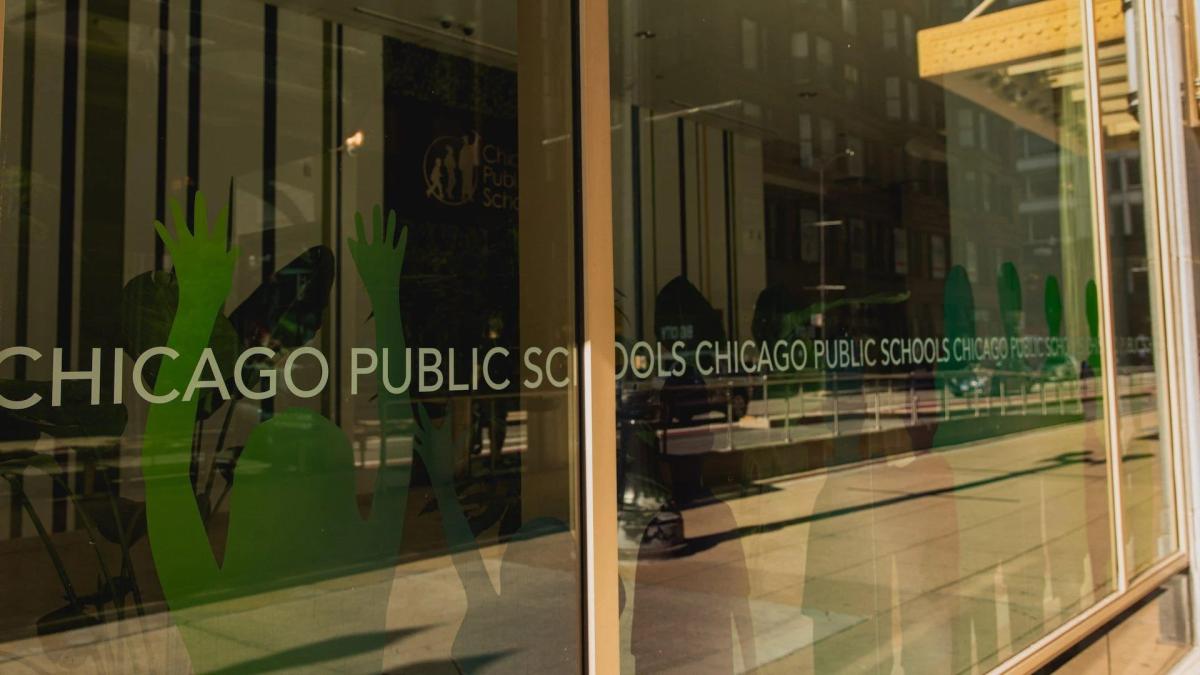
For decades, Chicago’s Board of Education has been the only one in Illinois handpicked by the city’s mayor. And for just as long, education advocates have called for that board to be an elected body, representative of Chicago’s diverse residents.
This fall, those advocates will get their wish.
For the first time ever, Chicagoans this November will vote on all 21 members of the city’s school board, as the board transitions from a partially-elected, partially-appointed board into a fully elected body.
But what does this change mean for the nation’s fourth-largest school district, its families and the board itself? We’ll explain it all here.
What do board members actually do?
The board has wide power over Chicago Public Schools, from selecting high-level officials and guiding the district’s overall direction and goals, to signing off on day-to-day decisions that affect every student, teacher and family.
Board members must OK the district’s multi-billion dollar annual operating budget, they approve the academic calendar — deciding when students are in and out of the classroom — and they control major policy decisions like the removal of police officers from school buildings.
How did we get here?
Chicago had been the only city in Illinois without an elected school board, and education advocates fought for years to eliminate mayoral control and bring Chicago’s board in line with the rest of the state.
In 2021, legislation was finally passed through both the state House and Senate before making its way to the desk of Gov. JB Pritzker. He signed the bill into law and said a fully elected board would help students and their families “have a strong voice in important decisions about the education system in Chicago.”
How will the elections this fall play out?
In 2024, Chicago was divided into 10 separate districts. Each of those 10 districts was then broken up into two halves — a and b. Currently, each district is represented by one elected and one appointed board member who must live in that area.
This fall, each of those 20 subdistricts will have a seat that’s up for grabs in the November election. Residents in each of those areas will then be able to vote on their school board representative.
The 21st seat — the citywide board president position — isn’t tied to any specific district and will be voted on by the city as a whole.
|
|
|
|
|
|
Sponsor Message
|
|
Life happens outside your comfort zone. Out Here, a courageous new musical at Court Theatre by Leslie Buxbaum, David J. Levin, and Erin McKeown, invites you to be among the first to experience Dawn’s journey. Torn between her husband, her family, and her ex-girlfriend Robin, Dawn must discover how to harmonize with those she loves and embrace change. Enjoy an intimate, joyful exploration of family, identity, and the choices that shape us. Out Here is on stage at Court Theatre April 10–May 10.
|
|
|
|
|
|
 |
(Jerry Nowicki / Capitol News Illinois)
|
Illinois lawmakers are continuing to debate reform efforts around controversial no-knock search warrants.
Anjanette Young has become the leading voice for reform, seven years after a botched police raid at the wrong address left her handcuffed while naked in her Chicago home. Now, a bill bearing her name could reshape how officers execute warrants in Illinois.
House Bill 1611, also known as the Anjanette Young Act, would ban no-knock warrants for many cases, except when the safety of officers or others is threatened. It would also limit when officers can execute search warrants at homes; set standards for training, identification, body-camera usage and access to medical services; and ban officers from pointing firearms at children, unless they present a clear and present danger.
State Reps. Kam Buckner (D-Chicago) and Angelica Guerrero-Cuellar (D-Chicago) joined “Chicago Tonight” to provide perspectives on HB1611.
Buckner is a chief sponsor of the bill. He said that no-knock warrants are a remnant of the war on drugs — “a foregone era,” according to Buckner — when law enforcement would try to enter a residence before evidence could be destroyed.
“What we’ve said is that unless things are extremely violent and aggressive, then cops should not be kicking in doors unannounced in the state of Illinois,” Buckner said.
Some debate:
The bill specifically outlaws no-knock warrants in cases where the only suspected crime is drug possession. However, Guerrero-Cuellar, a member of the House Judiciary Committee, expressed concerns with how the bill makes this distinction.
“The way the bill was presented, … they were trying to give a distinction between ‘low-level’ and ‘high-level’ crimes. And for me, if it’s a crime, it’s a crime,” Guerrero-Cuellar said. “We don’t know what’s necessarily inside of a home or in a building until the warrant is executed.”
Another concern Guerrero-Cuellar has is how the bill might affect rural and urban police departments differently. Coordinating medical services or backup support might be difficult in rural areas where staffing is low, and law enforcement might need to be drawn in from different counties.
|
|
|
|
|
|
|
|
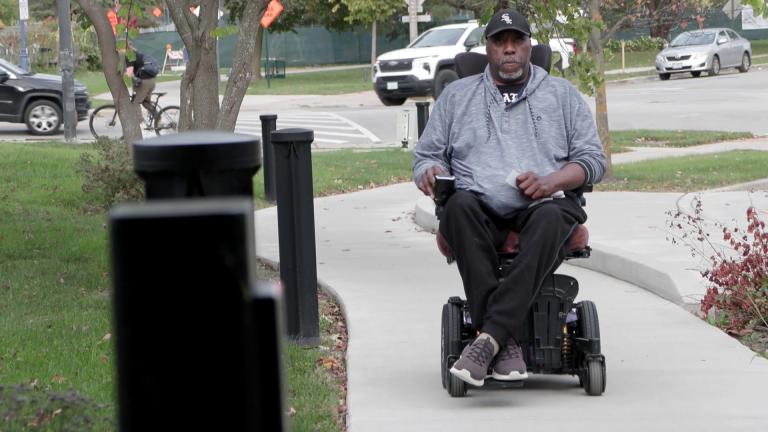 |
Mike Williams has accessible housing through Over the Rainbow Association. (Medill)
|
Chicago’s lack of affordable housing impacts thousands of residents across the city. This problem is exacerbated when accessibility accommodations, such as needing a wheelchair, are also necessary.
A 2009 shooting left former NBA player Mike Williams paralyzed from the waist down. Since then, he has needed a wheelchair to get around. One of the many problems he had to solve when his life changed was figuring out where he was going to live, since his former apartment didn’t accommodate his wheelchair.
“I was in the wrong place at the wrong time, suffered a gunshot wound, was injured there and then it became a series of nursing facilities and hospitals,” Williams said. “I had an advocate that mentioned OTR and I came out for an interview, filled out an application and it worked out pretty good.”
Over the Rainbow Association, or OTR, is a nonprofit that focuses on building accessible and independent housing for people with disabilities. It currently has 14 buildings across northern Illinois, including a new building in Chicago’s Lakeview neighborhood that opened in October 2025.
Eric Huffman is president of OTR. He said there is still more to be done to help solve the growing accessible housing crisis.
“You’re already thinking about what’s the next project, what’s in the pipeline,” Huffman said. “So, you know, while we were doing the Lakeview Landing, we also have two other projects in the pipeline right now that we’re thinking about doing.”
|
|
|
|
|
|
More From WTTW News:
|
Anne Pramaggiore and Michael McClain, two of the key players in the ComEd conspiracy case involving former Illinois House Speaker Michael Madigan, are both set to be released from prison and will be granted a new trial after an appellate court signaled it will toss out their landmark
convictions.
|
 |
|
|
|
|
Back in the Day: April 15, 1955 - Ray Kroc Opens First McDonald’s Franchise in Suburban Des Plaines
|
In 1955, Ray Kroc went into business with the San Bernardino-based McDonald brothers, who opened up a burger restaurant in Southern California. Kroc was impressed with their efficient, assembly-line business model, which they dubbed the “Speedee Service System," and offered to franchise the fast food joint nationwide. On this day 71 years ago, Kroc opened his first McDonald’s franchise in suburban Des Plaines. Built as a drive-in eatery, Kroc enlisted architect Stanley Meston to design the building with its signature golden arches. By 1961, Kroc had bought out the McDonald’s brothers for $2.7 million. McDonald’s now operates in over 100 countries with over 40,000 locations
worldwide. It’s the second-largest fast food chain next to China’s Mixue Ice Cream & Tea.
|
|
|
|
|
|
Chicago-Area Live Music Recommendations for April 15-21
|
Each Wednesday, WTTW News producer Josh Terry presents must-see live music shows from indie rock to jazz, country, hip-hop and more.
Thursday, April 16:
Courtney Marie Andrews, Aubory Bugg at Empty Bottle. Tickets.
A voice that warrants comparisons to fellow Arizonan Linda Ronstadt.
The Nude Party, Tobacco City at Lincoln Hall. Tickets.
Get there early for the neon-lit country of the local openers.
Friday, April 17:
Julian Saunders, Samuel Aaron, Orillia at Empty Bottle. Tickets.
The Chicago folkie headliner is celebrating his debut album “Two Geese.”
Yasmin Williams, Samuel Nalangira at SPACE. Tickets.
Expressive fingerstyle guitar in Evanston.
The Hoyle Brothers at Empty Bottle. Free.
Want a matinee show? This honky tonk residency is always on Fridays at 5:30 p.m. and always free.
Saturday, April 18:
Ratboys, Free Range at the Vic. Tickets.
Two of the best Chicago bands who also happen to be some of the city’s easiest to root for acts.
Sunday, April 19:
The Convenience, The Lipschitz, Seth Engel, Discus at Cole’s. Tickets.
Angular and anthemic indie rock from New Orleans.
Monday, April 20:
DAVE at Salt Shed. Tickets.
Not Chappelle, not Letterman, not the “Famous” BBQ restaurant chain, but the cerebral and celebrated U.K. rapper.
Tuesday, April 21:
Hayley Williams, Water From Your Eyes at Aragon Ballroom. Tickets.
The Paramore frontwoman enlists one of the coolest New York City bands as an opener.
|
|
|
|
|
|
|
What's your favorite fancy restaurant in Chicago?
|
|
|
Email DailyChicagoan@wttw.com with your responses and your answers might be published.
|
|
|
|

|
|
5:30 PM | 10:00 PM
|
|
|
|
Want more WTTW News content? Follow WTTW on Instagram to check in with us daily, go behind-the-scenes, and more.
|
Newsletter Producer: Josh Terry
|
|
|
|
|