Good morning. Did you feel the earthquake that happened off the North Shore yesterday? You're not alone. Start your Thursday with these local stories from WTTW News.
|
|
|
|
|
|
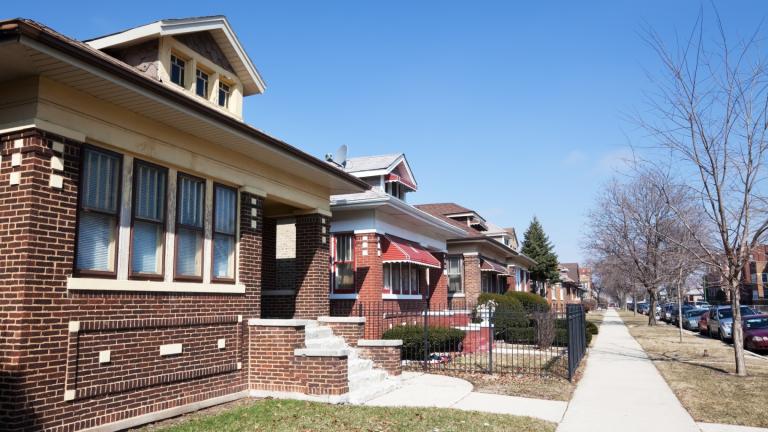 |
A file photo of a Chicago residential street. (stevegeer / iStock)
|
A bipartisan housing bill could help increase the amount of residential development in the U.S., but experts warn that material changes to the housing market will not be immediate, and the legislation may not go far enough in addressing the affordability issue.
The 21st Century ROAD to Housing Act, which passed the U.S. Senate in an 85-5 vote before clearing the U.S. House of Representatives 358-32, is the first major federal housing package in more than a decade. Its provisions include: a mandate for the U.S. Department of Housing and Urban Development to provide guidance on zoning and land-use policy reforms to local governments; grants and loans in support of new housing or the improvement of already-existing properties; and an increase in the limit for “Public Welfare Investment” for certain banks.
President Donald Trump has so far declined to sign the measure, calling it a “big yawn.” He instead is urging Congress to focus on the unrelated SAVE America Act, his controversial voter ID bill.
The housing bill will automatically become law on July 10 unless the president decides to veto it.
More context:
Much of today’s housing crisis is defined by lack of supply, said Geoff Smith, executive director of the Institute for Housing Studies at DePaul University. He said the mismatch between supply and demand can be traced back to the Great Recession. While demand for housing rebounded, new construction never fully recovered. In more recent history, record-low mortgage rates during the COVID-19 pandemic encouraged homeowners to refinance or buy homes before rates climbed back up, leaving many homeowners reluctant to sell. It’s a phenomenon economists call the “lock-in effect.”
“When you add these crises on top of each other and the various government interventions, you’re creating this ongoing crisis where the building and the development and the supply is really not matching the growing and the changing demand in Chicago and nationally,” Smith said.
Even if the legislation becomes law this week, Smith said not to expect immediate local changes.
The local government would first need to adopt the new policies, he said, then developers would need to secure financing, purchase land, obtain permits and complete construction before new housing reaches the market.
|
|
|
|
|
Sponsor Message
|
|
The Chicago Symphony Orchestra returns to Ravinia this summer for its 90th summer residency, featuring world-class performances, celebrated conductors, and unforgettable nights in the newly transformed Hunter Pavilion. Plan an evening of extraordinary music in one of Chicago's most beloved outdoor settings. Get tickets at www.ravinia.org!
|
|
|
|
|
 |
Mayor Brandon Johnson addresses the news media on Tuesday, July 7, 2026. (Heather Cherone / WTTW News)
|
Mayor Brandon Johnson said Tuesday that Chicago is heading into the second half of 2026 with a budget gap of at least $130 million after revenue baked into the city’s 2026 spending plan over his objection failed to materialize.
Johnson, who neither signed nor vetoed the $16.6 billion spending plan approved by the Chicago City Council, allowing it to take effect, stopped short of telling reporters layoffs or service cuts would be necessary to bridge the gap, as he warned in January.
But Johnson minced no words in blaming those members of the City Council who refused to approve a spending plan for 2026 that included new taxes on large firms, saying they had chosen to align themselves with corporations over the people of Chicago.
“I want to say this clearly,” Johnson said at a City Hall news conference. “There were other options. We did not need to cede to big money interests and fall back on the tired practice of balancing budgets on the backs of working people.”
Some backstory:
Johnson said the City Council should have adopted his proposal to levy a $33 per month per employee tax on companies with 500 or more employees in order to generate between $82 million and $100 million.
However, the group of alderpeople who crafted the spending plan accused Johnson in a statement of failing to “fully implement” the spending plan approved by the City Council.
“Mayor Johnson and his administration have spent six months slow-walking the implementation of new revenues and efficiencies designed to close our budget deficit and prevent this administration from creating excuses to raise taxes on businesses, jobs and working families and skip the remainder of our advance pension payment,” according to the statement released by the office of Ald. Samantha Nugent (39th Ward).
The city’s budget relies on $89.6 million in new revenue from debt collection efforts. Johnson blocked medical debt owed to the city from being included in that attempted sale. Despite diligent efforts to find a firm interested in pursuing that debt, no buyers have responded to the city’s requests for proposals, Johnson said.
|
|
|
|
|
|
|
|
 |
Beluga whales at Shedd Aquarium will soon have company. (Brenna Hernandez / Shedd Aquarium)
|
An unprecedented international rescue effort is underway to find new homes for some 30 beluga whales currently in limbo after the mammals’ marine park in Canada closed.
Shedd Aquarium announced it’s stepping up to the challenge and is preparing to accept as many as 10 of the whales, aquarium officials said.
Other facilities participating in the rescue include Georgia Aquarium, SeaWorld San Antonio and SeaWorld San Diego in the U.S., along with Oceanogràfic de València in Spain.
Dr. Karisa Tang, who oversees the veterinary medical program at Shedd Aquarium, said the rescue “provides the best possible life for these belugas.”
The belugas’ plight has been making headlines in Canada for months. The whales’ current home at Marineland, a longtime tourist attraction in Niagara Falls, Ontario, has been cited by the Canadian government for animal welfare concerns. Animal rights advocates had argued for the belugas’ release into a marine sanctuary.
Kayley Galassini, a spokesperson for Shedd Aquarium, told WTTW News that no sea pens currently exist with the capacity or level of care the belugas need.
“This rescue is needed now,” Galassini said, “and Shedd can provide the expert care required.”
What’s next?
Shedd has a long history of caring for belugas, which make their home in the aquarium’s 3-million-gallon Abbott Oceanarium.
Due to the complexity of the rescue, the exact timeline remains fluid for the belugas’ arrival in Chicago, but the rescue is likely to occur within the next few weeks. The whales will be flown in temporary holding tanks designed specifically for belugas, and veterinarians and caretakers will be by their sides the entire time, Tang said.
As the belugas settle into their new home, they will be closely monitored for signs of healthy adjustment or distress.
|
|
|
|
|
|
More From WTTW News:
|
|
|
 |
|
|
|
Back in the Day: July 9, 1896 - William Jennings Bryan’s ‘Cross of Gold’ Speech
|
On this day 130 years ago, the Democratic National Convention was in full swing at the Chicago Coliseum. Following the Panic of 1893, which caused a depression, much of the convention focused not only on picking a candidate to defeat Republican nominee William McKinley but also how to get the United States out of its economic slump. William Jennings Bryan had an idea on July 9, 1896, when he gave his famous “Cross of Gold” speech on the convention floor. He railed against the prevailing gold standard, saying, “you shall not crucify mankind upon a cross of gold” and called for free silver to inflate the economy and alleviate debt for the working class. Jennings Bryan would
become the Democratic nominee — the youngest ever at the time at 36 — but would lose in the general election to McKinley. The U.S. would abandon the gold standard domestically in 1933 and internationally in 1971.
|
|
|
|
|
This Week’s Arts and Culture Events
|
Every Thursday, WTTW News newsletter producer Josh Terry highlights his picks for the week’s must-see cultural events.
Chicago has made it through a heat wave, a deluge of thunderstorms and more this summer. No matter the weather, locals here prefer to be outside. If we can endure blistering winters, a little precipitation and sweat won’t keep us isolated indoors. This week, you can enrich your cultural life with any one of these options. Like movies? Well, there’s a massive film festival happening across multiple venues. Want to laugh? The Cubs are out of town, and John Mulaney is taking over the ballpark. Read on for what else is on offer.
Film: Mubi Fest — Various Locations
If you like arthouse cinema, Mubi is one of the best streaming services. It’s also a production company and film distributor and several of its titles have received Academy Award nominations, like “The Substance.” This weekend, Mubi is hosting a multi-day film festival at Salt Shed, the Music Box and the Gene Siskel Film Center. You can spend the whole day taking in screenings, like the premiere of Jane Schoenbrun’s “Teenage Sex and Death at Camp Miasma” or a 25th anniversary presentation of Wes Anderson’s “The Royal Tenenbaums.” For the full list and tickets, click here.
Art: “Echoes of the Afterlife” — Golden Triangle
Tucked on Grand Avenue in West Town is not your average antique store. The Golden Triangle specializes in luxury items from Asia and Europe, and it also has a museum showroom in its building. This summer, “Echoes of the Afterlife” has been on display there, which is “the largest exhibit and public sale of ancient Chinese tomb pottery in North America.” You can find “two hundred pieces of terra cotta pottery and bronzes spanning the period between 2000 BCE and 1000 CE.” For more information, click here.
Comedy: John Mulaney — Wrigley Field
Whenever I see stand-up comedy, it’s usually in a small club. There’s a drink minimum, and there are maybe 100 people there, tops. While Wrigley Field is not an intimate venue, it is a proper spot for the stratospherically popular comic John Mulaney. He’s a Chicago-raised, St. Ignatius College Prep alum who has soared in his career since he first became a writer on "Saturday Night Live" from 2008-2013 to his current Netflix talk show and countless TV standup specials and appearances. You can still buy tickets to his homecoming stadium show here.
|
|
|
|
|
|
|
What's one touristy thing that every Chicagoan should do in the city?
|
|
|
Email DailyChicagoan@wttw.com with your responses and your answers might be published.
|
|
|

|
|
5:30 PM | 10:00 PM
|
|
|
Want more WTTW News content? Follow WTTW on
Instagram to check in with us daily, go behind-the-scenes, and more.
|
Newsletter Producer: Josh Terry
|
|
|
|
|