Tropical Storm Dolly formed Thursday in the Atlantic Ocean and while it wasn’t named for the late superstar, who died Tuesday at age 80, there’s no question Dolly Parton was a force of nature.
She was also, it turns out, a force for nature.
There was, of course, her affinity for butterflies. She often talked about chasing them into the woods as a little girl, had an early hit song with “Love Is Like a Butterfly,” and wove the insect into Dollywood’s logo. What I didn’t know was that Dollywood was also home, for 35 years, to a sanctuary for bald eagles.
The sanctuary gave injured eagles permanent refuge if they couldn’t be returned to the wild — it was the largest such facility in the world — but staff also rehabbed birds for release. According to a report from the BBC, Parton’s sanctuary released nearly 200 bald eagles into the wild, and her conservation efforts earned her a Partnership Award from the U.S. Fish and Wildlife Service in 2003.
In these highly polarizing times, Dolly was that rare individual who transcended divisions, and that applied to the natural world as well. Adding to her Fish & Wildlife honor, Parton had a lichen named after her. A lichen! Its common name is Dolly’s Dots and its Latin botanical name is even better: Japewiella dollypartoniana. The lichen was first described as a new species in 2015 and because it was found in the Appalachians, scientists gave naming rights to the mountains’ favorite daughter. Look for this gem on trees and
shrubs in the middle to high elevations of the Appalachians.
|
|
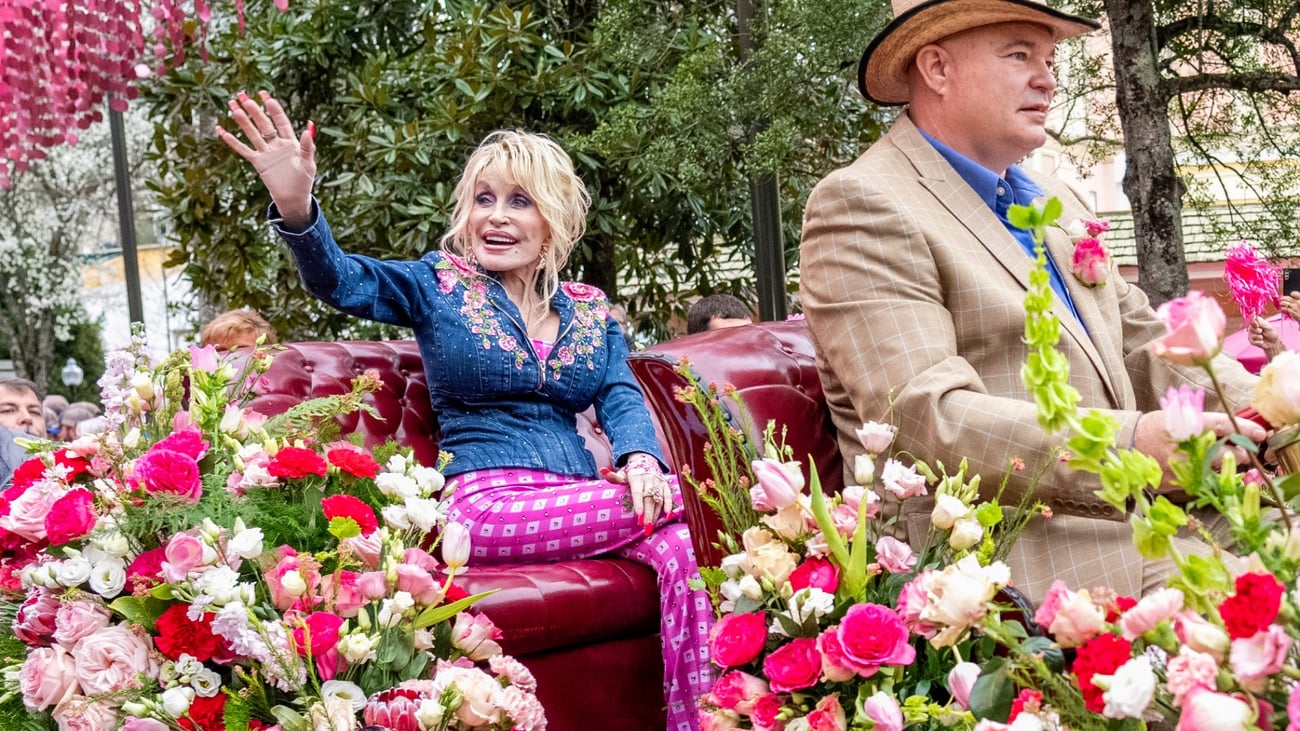
Dolly Parton appears at Dollywood's Season Passholder and Media Day in Pigeon Forge, Tenn., March 8, 2024. (Photo by Amy Harris / Invision / AP, File)
|
I learned all of this, and more, from some of the many, many tributes to Parton that have flooded my social media feeds since her death. While a lot of those posts, as expected, were shared by her fellow musicians, co-stars and entertainers, it was a clip from a 2022 interview with National Geographic that held my attention.
“My hope for the environment, for all things living and all things good, just nature in general: That we should pay more attention to how we’re treating our mountains, how we’re treating our world, how we’re just treating everything,” Parton said. “We’re just mistreating Mother Nature. That’s like being ugly to your mama. That’s like being disrespectful. Seriously. So I really think we all need to pay closer attention to taking better care of the things that God gave us freely and that we’re so freely messing up.”
That’s classic Dolly, truth-telling wrapped in the guise of a joke — “being ugly to your mama.” But then she says, “Seriously.” And the poet-songwriter delivers that beautifully phrased indictment: “that God gave us freely and that we’re so freely messing up.”
That same year, the asteroid formerly known as 1998 BL3, discovered in 1988, was named DollyParton, as noted by the International Astronomical Union. It’s a “main belt” asteroid, floating around out there between the orbits of Mars and Jupiter with other remnants from the early solar system.
She’s star dust now.
|
|
|
Patty Wetli
WTTW News Digital Reporter
|
|
|
|
 |
ICYMI |
|
|
|
|
|
|
|
|
Thanks to our sponsors:
|
|
|
|
|
|
|
|
|
Clippings: News & Notes |

|
Sandhill cranes are a tourism boon to Kearney, Nebraska. Officials there approved regulations to protect habitat used by the birds from wind energy development. (karenfoleyphotography / iStock)
|
Local: The Lake County Forest Preserve District announced it’s partnering with the U.S. Army Corps of Engineers on an ambitious $15 million restoration of the nearly 800-acre Dutch Gap Forest Preserve in Antioch. The focus will be on reviving the land’s natural wetlands and streams
after decades of agricultural use. “For decades, water was redirected away from these wetlands,” said Pati Vitt, director of natural resources. “This restoration will allow the land to function as nature intended, improving water quality, reducing flooding and creating healthier habitat for wildlife.”
Local: It’s been a rough week for Chicago’s zoos and aquariums. RIP Ozzy, Lincoln Park Zoo’s resident male snow leopard, whose health rapidly deteriorated this week. Ozzy was born in 2018 and arrived at Lincoln Park Zoo in 2021. When he wasn’t cat-napping, Ozzy spent a good
amount of time with his mate Kennedi, even though snow leopards tend to be solitary creatures.
Nation: Audubon Great Plains is celebrating a big win for sandhill cranes in Nebraska, where officials approved wind energy regulations that protect a corridor along the Platte River, a vital stopover point for the migrating birds. Infrastructure such as turbines must be set back at
least seven miles from the river. These regulations, Audubon said, offer an example of the balance between renewable energy development and the conservation of critical wildlife habitat.
World: Bats usually only make the news when one of them turns up rabid. They really deserve better PR, so here you go. New research out of the University of California Berkeley suggests bats may not only hold the key to living longer but to staying healthy in old age. “Bats
have evolved this incredible fitness capacity, this incredible ability to deal with disease and this incredible ability to be able to prevent cancer,” the study’s lead researcher said.
Wildcard: Last week, I shared an update on Citizens for Conservation’s (CFC) efforts to restore a former horse farm to native habitat. As part of my visit to the Hill ‘N Dale Preserve, CFC staff took me on a tour of the nearby Grigsby Prairie, to offer an example of what a mature restoration site looks like after decades of stewardship. Check out video footage from our walk through the tallgrass.
|
|
|
|
|
Creature Feature: Viceroy Butterfly
|
|
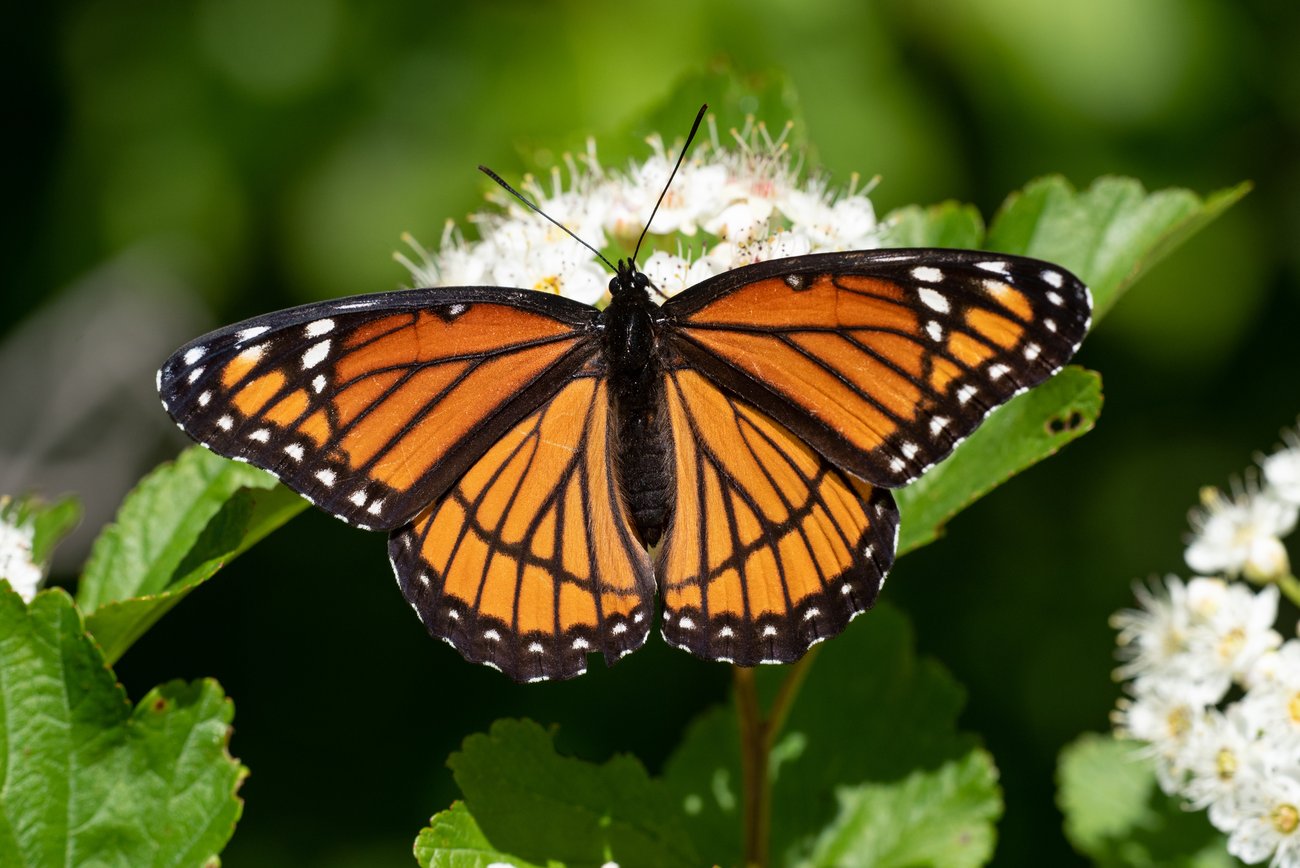
The Viceroy butterfly, with the telltale black band across the veins of it hind wings. (bookguy / iStock)
|
I can’t believe that in all the reporting I’ve done on the Monarch butterfly, not once did I come across a note warning me of an imposter. From a distance, the copycat Viceroy butterfly’s orange-and-black stained-glass wing pattern (Limenitis archippus) is all but indistinguishable from
the Monarch’s, and that’s the point. The Viceroy is one of nature’s mimics, which apparently helps it ward off predators, though that’s up for debate. Now I’m questioning how many of my Monarch sightings over the years have actually been Viceroys. The easiest way to tell the two apart: Viceroys have a black band across the veins of their hindwings. Its caterpillars are nothing like the Monarch’s — they look like bird droppings and they feed on willows and poplars.
|
|
|
|
|
Nature Calls: Events & Activities
|
|
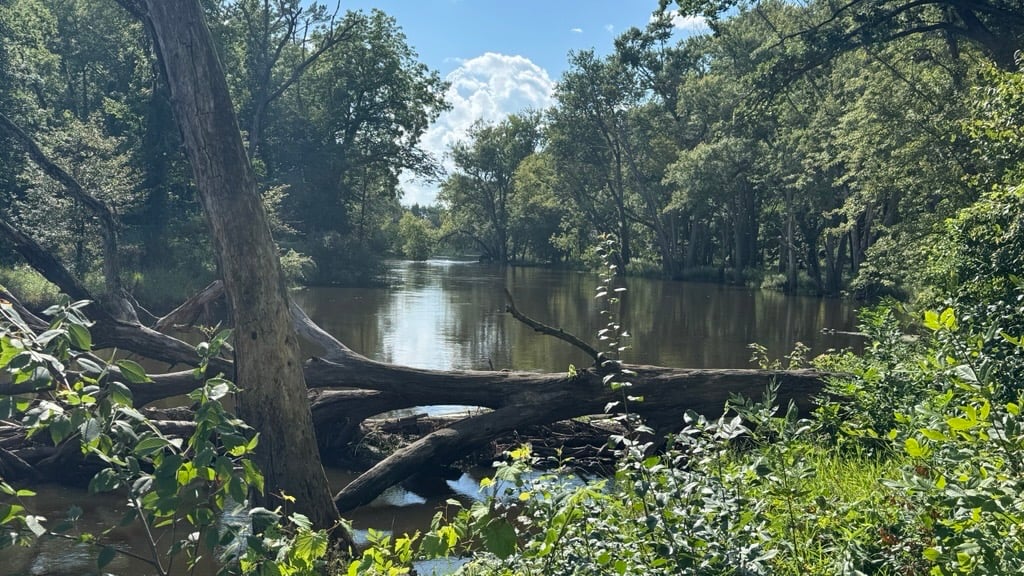
Lovely view of the Des Plaines River at Ryerson Woods. (Patty Wetli / WTTW News)
|
Chicago Bird Collision Monitors is recruiting people to join downtown monitoring teams for fall migration. Upcoming trainings are scheduled for Aug. 29 and Sept. 12, 23 and 27. Sessions are held at the Peggy Notebaert Nature Museum, 11 a.m. to 1 p.m.; the Sept. 23 training will be at the
Humboldt Park Chicago Public Library branch, 5:30-7:30 p.m. Registration required: call 773-456-2473.
Just a reminder that it’s still summer. Twenty of the Chicago Park District’s neighborhood pools remain open through Sept. 7. Check the district’s website for pool hours and schedules. All of the city’s beaches are open for swimming as well, when lifeguards are present, 11 a.m. to 7
p.m.
Last weekend, my husband and I spent a relaxing afternoon exploring Lake County’s Ryerson Conservation Area. There are more than six miles of trails to wander — I’d give the whole system an “easy” rating — and we covered most of them. I notched a couple of new plant observations
(hello, American groundnut!), saw several hummingbirds and shared a bench with a katydid at one point. If you go, you’ll need bug spray more than sunscreen. I always measure these excursions on a scale of “Worth the drive from Chicago or not?” and this one gets a “yes!”
“Remnants 2026” is an interactive, place-based theatrical experience — for lack of a better description — happening Saturday and Sunday at Marian Byrnes Park, 6 p.m. to dusk. During the performance, audience members will move around the park, following “spirits” (giant puppets)
representing remnant prairies, wetlands, savannas and woodlands. The event is free; BYO blanket and snacks.
Rare plants need monitoring too! Join a foray at Orland Grassland, Sept. 5 at 9 a.m., where folks from the Plants of Concern program will demonstrate their techniques. Capacity is limited, so register ASAP if you’re interested. General information on volunteering with the program is available online.
|
|
|
|
|