Today’s Daily Chicagoan is brought to you, in part, by:
|
|
|
|
|
It’s Wednesday. Take a minute to read through the latest stories from WTTW News.
|
|
|
|
|
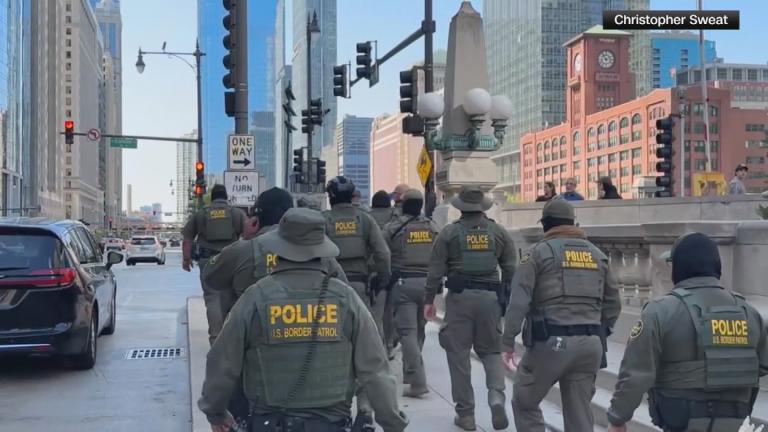 |
Federal agents walk through downtown Chicago in this file photo. (Courtesy of Christopher Sweat)
|
It’s been one year since “Operation Midway Blitz” began, when federal agents from Immigration and Customs Enforcement and Border Patrol ramped up arrests of immigrants throughout the Chicago region.
Now, the chaotic scenes that marked the height of the operation — masked agents on neighborhood streets, protests outside of the crowded Broadview detention facility — have largely faded. But immigration-related arrests have continued.
While officials continue to look for legal accountability for agents accused of wrongdoing, many immigrants face confusing “mega master” court hearings, with their legal status in the balance. Meanwhile, the communities hit hardest by last fall’s deportation campaign are still navigating this new landscape.
“You feel a sense of normalcy that’s come back to the community,” said Marcela Rodriguez, executive director at Enlace Chicago.
“But at any rumor of a sighting of ICE, any car that’s unmarked, has no plates, has tinted windows, it triggers people,” Rodriguez said. “And you begin to start seeing the effects of that fear returning into the community.”
During “Midway Blitz,” word got out about the conditions detainees faced at the Broadview detention facility. Now, the facility has largely emptied out, with detainees quickly transferred out of state.
Samuel Cole, chief immigration legal counsel at ACLU of Illinois, was part of a group that sued over the conditions and eventually gained access to the facility.
The Illinois Accountability Commission collected evidence of what it deemed “illegal and violent conduct” during “Midway Blitz.” However, Cook County State’s Attorney Eileen O’Neill Burke has not acted on those findings, saying only law enforcement can initiate investigations.
“In this moment it’s not about the policy we’re setting forth, it’s about the political will to continue investigations, to pursue the evidence, to continue to fight for justice for the residents of Illinois,” state Sen. Graciela Guzmán (D-Chicago) said.
The economic impact:
A new report from the University of Illinois Chicago estimates $1.26 billion of retail and restaurant activity was lost due to the intensified federal immigration enforcement.
The report, “Hunkering Down: The Hidden Economic Cost of Federal Immigration Enforcement in Cook County, IL,” estimated $107 million was lost in local sales-tax revenue.
Researchers also found cross-community trips to restaurants, shopping, entertainment and other discretionary destinations fell 9% while trips to essential destinations, such as grocery stores, pharmacies, gas stations, banks and healthcare providers, fell nearly 8%.
|
|
|
|
|
Sponsor Message
|
|
Andersonville Internal Medicine is a Chicago-based concierge practice providing personalized primary care for adults through a relationship-centered, membership-based model. By caring for a smaller patient panel, our physicians are able to offer extended appointments, proactive preventive care, and 24/7 direct access. We provide same-day or next-day appointments, as well as regular health check-ins focused on both chronic disease management and long-term wellness.
Our concierge care model emphasizes seamless, personal, and consistent care over time. Call or inquire online for a complimentary meet and greet appointment in either Andersonville or Evanston. Healthcare as it should be.
|
|
|
|
|
|
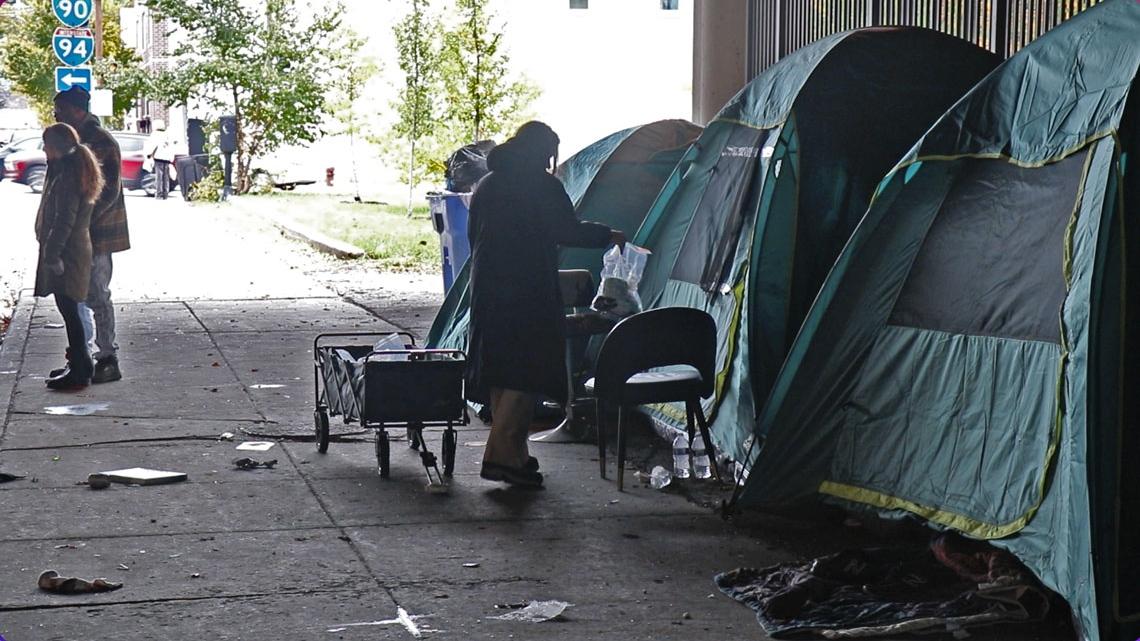
A volunteer with Street Samaritans hands out a care package to a person camping underneath a bridge in November in the Chicago area. (Jacques Abou-Rizk / Medill Illinois News Bureau)
|
The number of Chicagoans living in city shelters or on city streets dropped 12% between January 2025 and January 2026 but remains near an all-time high, according to the annual survey used by federal officials to track homelessness.
Approximately 6,527 people in Chicago lacked a permanent place to sleep on Jan. 22, according to the annual “point-in-time” count, which sends volunteers out to count the number of unsheltered people on the city’s streets on a single night and is used by U.S. Department of Housing and Urban Development officials to determine federal funding levels.
That reflects a 65% drop from January 2024, when 18,836 men, women and children were living in city shelters or on the streets, including 13,891 new arrivals to the city, records show.
More context:
In all, 46,282 people arrived in Chicago between August 2022 and December 2024 after requesting asylum, many on buses paid for by Texas Gov. Greg Abbott, a Republican, according to Chicago’s inspector general.
The city’s 2026 survey of unhoused residents is the first since January 2022 not to distinguish between longtime residents and new arrivals to Chicago.
The number of Chicagoans living in city shelters dropped more than 20% between January 2025 and January 2026, according to the survey.
Chicago officials attribute the drop in the number of people living in city shelters to the significant decrease in the number of Chicagoans city officials once classified as “newcomers” or “new arrivals” people who were born in another country but recently arrived in Chicago, amid President Donald Trump’s efforts to limit immigration.
However, approximately 1,641 Chicagoans were completely unsheltered on the city’s streets at the time of the survey, an increase of nearly 25% from the 2025 survey, according to the results.
Excluding the surveys conducted during the migrant crisis, homelessness in Chicago hit the highest level in 2026 since 2015, when 6,786 Chicagoans lived in city shelters or on city streets. Approximately 2,055 people were completely unsheltered in 2015, records show.
|
|
|
|
|
|
|
|
|
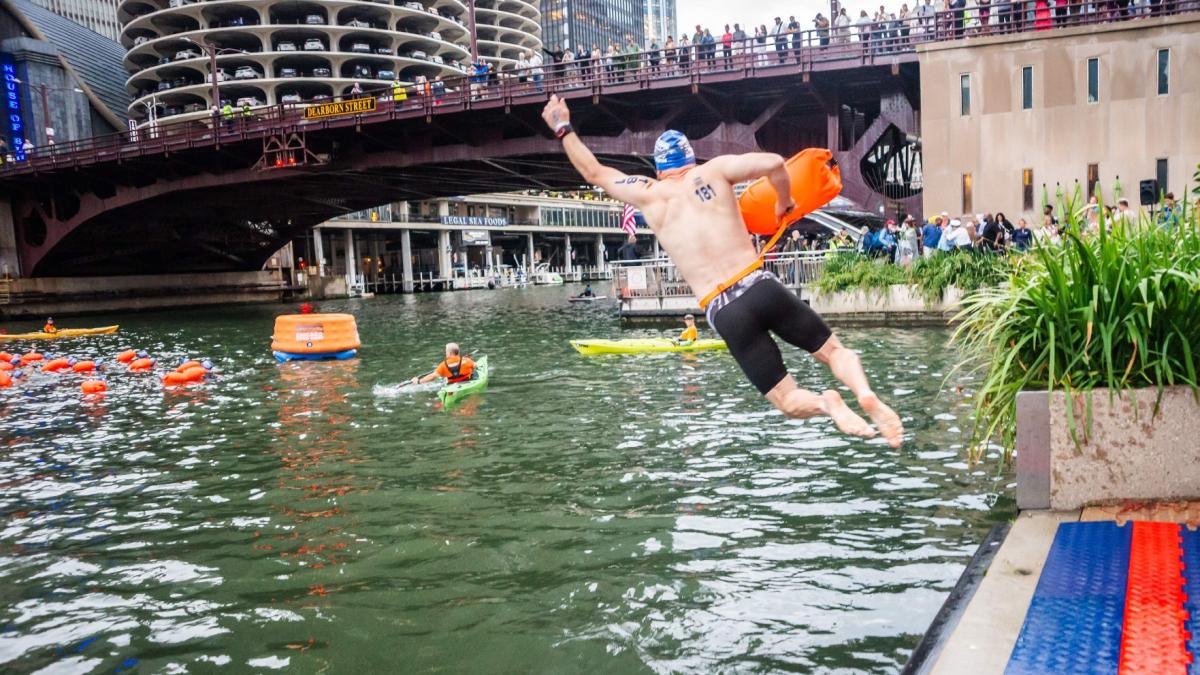
A participant enters the water during the 2025 Chicago River Swim. The Big Jump has been added to the 2026 event for folks prepared to take the plunge but not go the distance. (Linda Barrett / Chicago River Swim)
|
Organizers have announced an addition to the upcoming open water Chicago River Swim: the Big Jump.
The jump — think cannonball, belly flop or dive — is a way to take part in the river swim celebration without having to go the one- or two-mile distance of the main event.
A limited number of just 100 public slots are available for the jump on a first-come, first-served basis. Participants must be 18 years of age or older; the registration fee is $500.
Average folks will take the plunge alongside Olympians, celebrities, elected officials, civic leaders and others as they make a splash on Sept. 18, in advance of the swim on Sept. 20.
“The Chicago River belongs to all of Chicago, and the Big Jump is a powerful way to celebrate how far our city has come,” said Mayor Brandon Johnson, who will serve as the event’s emcee. “For generations, Chicagoans have worked to restore this river and reconnect our communities to it.“
The field for the swim itself has been expanded to 750 qualified swimmers, up from the initial cap of 500 swimmers. Registration has been reopened for individuals who want to tackle the longer challenge.
Proceeds from both the jump and swim events will support ALS research and youth swim education.
The inaugural Chicago River Swim was held in 2025, with 263 people taking part in the first organized open-water swim in the river in 98 years.
|
|
|
|
|
|
More From WTTW News:
|
|
 |
|
|
|
|
Back in the Day: September 9, 2006 - Marshall Field’s Becomes Macy’s
|
Marshall Field and Company was a pioneering department that was founded in 1852 by businessman Potter Palmer as P. Palmer & Company. In 1865, Palmer entered a business partnership with fellow entrepreneur Marshall Field, who renamed the store in 1881 and ushered it to its 1902 flagship location at State and Lake. On this day 20 years ago, when Marshall Field’s was a chain with over 60 stores across eight states, it became Macy’s thanks to a sale to the retail giant. The name change occurred less than a year after the Marshall Field and Company Building was designated a Chicago Landmark. Protestors gathered under the building’s iconic clocks on State Street to decry the sale.
For more on Marshall Field’s and its sale to Macy’s, revisit our “Chicago Stories” episode on the iconic shop’s history.
|
|
|
|
|
Chicago-Area Live Music Recommendations for Sept. 9-15
|
Each Wednesday, WTTW News producer Josh Terry presents must-see live music shows from indie rock to jazz, country, hip-hop and more.
Wednesday, Sept. 9:
James K, Dorothy Carlos, gs70 at Empty Bottle. Tickets.
This Ukrainian Village club kicks off its annual Plantasia festival with a pre-party.
Thursday, Sept. 10:
Erykah Badu, De La Soul, The Alchemist at Ravinia. Tickets.
Several icons of hip-hop team up in Highland Park.
Helado Tropical, James K, Gigi Masin, Elori Saxl, Henry Solomon, Blue Earth Sound, Jeremiah Chiu, Age of Peace, Torn Light DJs at Garfield Park Conservatory. Tickets.
A celebration of ambient, electronic and jazz music takes place in a unique venue. Night one of two.
Noname at Park West. Tickets.
The Chicago rapper and poet celebrates 10 years of her breakthrough album “Telefone.” Night one of two.
Friday, Sept. 11:
Makaya McCraven, Green-House, Precious Renee Tucker, Chee Shimizu, Okonski, Flore Laurentienne, Gwenifer Raymond, Acopia at Garfield Park Conservatory. Tickets.
A celebration of ambient, electronic and jazz music takes place in a unique venue. Night two of two.
Noname at Park West. Tickets.
The Chicago rapper and poet celebrates 10 years of her breakthrough album “Telefone.” Night two of two.
The Punch Brothers at Cahn Auditorium. Tickets.
Expect expert pickin’ and gorgeous harmonies from Chris Thile’s virtuosic roots band.
Saturday, Sept. 12:
Alison Krauss & Union Station at Ravinia. Tickets.
This acclaimed singer loves this Highland Park stage.
Trampled by Turtles, Sierra Hull, Valerie June, Mdou Moctar, Tobacco City, more at Evanston Folk Festival. Tickets.
Head up to Evanston for a festival devoted to the best folk and Americana acts. Night one of two.
Sunday, Sept. 13:
Indigo Girls, Josh Ritter, James McMurtry, Margaret Glaspy, more at Evanston Folk Festival. Tickets.
Head up to Evanston for a festival devoted to the best folk and Americana acts. Night two of two.
Monday, Sept. 14:
Bikini Kill, Ganser at Salt Shed. Tickets.
Two generations of women-led punk bands.
Tuesday, Sept. 15:
Carla Dal Forno, Zelienople, Erik Kramer at Empty Bottle. Tickets.
The Australian songwriter has one of this newsletter producer’s favorite LPs of 2026.
Sondre Lerche, Julian Saunders at Lincoln Hall. Tickets.
This charming Norwegian songwriter will bring his solo show to Lincoln Park.
Thomas Dollbaum, Glass Beagle at Hideout. Tickets.
“Birds of Paradise” is one of the best rock albums of the year.
|
|
|
|
|
|
|
What's the No. 1 thing Chicagoans should do outside before summer is over?
|
|
|
Email DailyChicagoan@wttw.com with your responses and your answers might be published.
|
|
|

|
|
5:30 PM | 10:00 PM
|
|
|
Want more WTTW News content? Follow WTTW on
Instagram to check in with us daily, go behind-the-scenes, and more.
|
Newsletter Producer: Josh Terry
|
|
|
|
|